
Have you ever seen a building under construction? You’ve probably noticed scaffolding, temporary structures that look like a giant grid of poles and boards, which surround the building to support workers during construction. Here in the United States, scaffolding is most often made of wood or metal. But some places, such as Hong Kong and southern China, still use the ancient practice of building scaffolding from bamboo. It’s created by tying bamboo poles together with nylon straps or metal wires to create a strong, flexible framework.
The practice of bamboo scaffolding began with the Han dynasty, about 2,000 years ago, and continued in mainland China until the 1990s. Then new laws required that scaffolding be made from steel and aluminum for buildings over six stories high. However, it continues in Hong Kong today, where it has been used to build some of the city’s tallest buildings, such as the 88-floor International Finance Centre. Today, about 80 percent of scaffolding in Hong Kong is created using bamboo, while the other 20 percent use metal or a hybrid of the two. Earlier this year, the Hong Kong government announced that half of all new public building projects would need to use metal scaffolding. This raises the question: does the ancient practice still have a place in modern construction? Here, btw takes a closer look.
Advantages of Bamboo
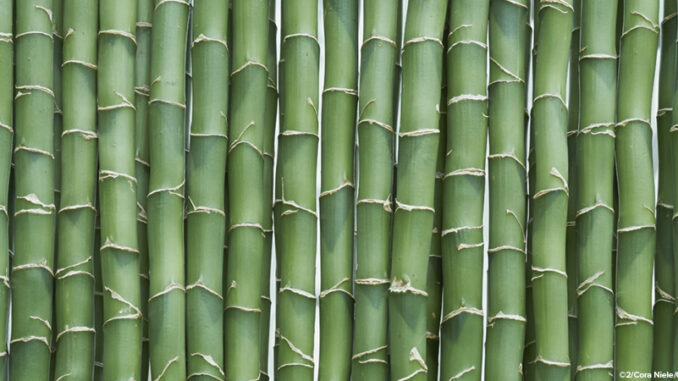
Bamboo is known for its strength, which is comparable to steel. Also, its natural fibers distribute weight more evenly, which makes it more durable. It’s also more flexible for metal, great for fitting around oddly shaped structures without the need for much advance calculation. Bamboo is exceptionally light, meaning structures can be moved and assembled very easily and quickly. This reduces overall labor costs and makes construction projects take less time.
Affordability is another factor: in southern China and Hong Kong, bamboo grows in abundance, making it far cheaper than steel or aluminum. Bamboo scaffolding can also be taken apart and rebuilt again to be used for other structures, further saving costs. It grows much faster than hardwood trees, and decomposes naturally, making it an eco-friendly solution.
Disadvantages
However, despite its many advantages, using natural bamboo for construction projects has disadvantages as well. It is more vulnerable to weather, such as rain and humidity, which causes it to weaken, rot, or mold. Extreme heat can also dry it out, making it more likely to crack. A protective coating can be applied to give bamboo better defense against the weather.
Because it is natural, bamboo is also more flammable than steel or aluminum. Its stregth can be affected by the species and age of the plant and must be inspected carefully before use. But perhaps the biggest drawback is that building bamboo scaffolding takes special skills, which have been passed down from generation to generation. But as many construction workers age out of the trade, fewer younger people are willing to learn the skill.
Recently, the safety of bamboo scaffolding has come into question. The Hong Kong government reports that from January 2018 to August 2025 there were 24 deaths in Hong Kong related to bamboo scaffolding. But the workers’ union insists that bamboo is not unsafe, and that these numbers don’t show the whole picture.
Other Uses
Because of its many qualities, bamboo scaffolding is also used for structures other than construction, such as to cover air conditioning units and balconies. Aside from scaffolding, bamboo is used to make everything from clothing to furniture to flooring. In Hong Kong, it is used to create traditional theaters, temporary events and exhibits, and cultural and religious installations. Regardless of whether the ancient tradition of bamboo scaffolding continues, bamboo will continue as a cost-effective, ecologically-sound option in many industries.