
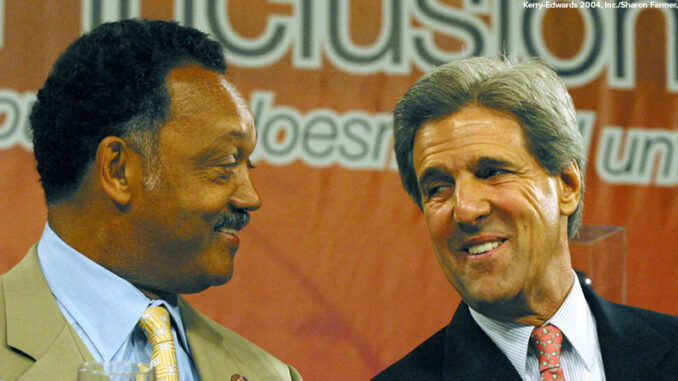
Black History Month is a time to recognize and celebrate the history, culture, and contributions of African Americans. Jesse Jackson, an important civil rights activist and leader, died on February 17, 2026, at the age of 84. Jackson was a fighter for social justice during three eras of American history: the Jim Crow era of racial segregation; the civil rights movement; and the post-civil rights era that saw the election of President Barack Obama and the rise of the Black Lives Matter movement. Here, btw takes a closer look at his life and legacy.
A Young Activist
Jesse Jackson was born in 1941 in Greenville, South Carolina. His mother was an eighteen-year-old unmarried high school student. His father was his 33-year-old married next-door neighbor. Jackson grew up in the South during the Jim Crow era. He experienced legal racial segregation, such as being required to use separate water fountains and attend all-Black schools. After he graduated high school, Jackson attended North Carolina A&T, where he was student body president, an honor student, and the first-string quarterback on the football team.
While in college, Jackson was also inspired to join the civil rights movement. In 1965, he participated in Dr. Martin Luther King, Jr.’s voting rights march from Selma to Montgomery, Alabama. Jackson met Dr. King and eventually became one of King’s closest aides.
Dr. King sent Jackson to Chicago to launch Operation Breadbasket–an effort to pressure companies to hire African American workers. Jackson was with him in Memphis, Tennessee when Dr. King was assassinated on April 4, 1968. Jackson determined to keep the fight for equality going.
Continuing Dr. King’s Legacy
Inspired by the work of his mentor, in 1971, Jackson formed the PUSH (People United to Save Humanity) Coalition, an organization based in Chicago. The group used boycotts, lawsuits, and other tactics to carry out its widespread mission. The PUSH Coalition worked to diversify workforces, operate voter registration drives, and other social efforts in predominantly Black neighborhoods.
Jackson also sought to make change on the political front. He was a Democratic Party presidential candidate in 1984 and 1988. (He came in third behind Walter Mondale and Gary Hart in 1984. In 1988 he was the runner-up nominee, after Michael Dukakis.)
Jackson changed the widespread perception that an African American would never be a viable candidate for president. In fact, he did better than any Black politician up to President Obama. He was also the first presidential candidate to make support of LGBTQ+ rights a major part of his campaign platform. Jackson helped the Democratic Party become more inclusive and progressive. Though he decided not to run for president a third time, he did serve one term as a senator from Washington, D.C.
Modern Times
In 1996, Jackson merged PUSH with the Rainbow Coalition, forming the Rainbow PUSH Coalition, or RPC. RPC is an international human and civil rights organization headquartered in Chicago. It is an alliance of Black Americans, white Americans, Latinos, Asian Americans, Native Americans, and the LGBTQ+ community. It uses grassroots activism to preserve and promote civil rights for everyone all over the world.
To date, the RPC has awarded $6.1 million in college scholarships, facilitated the hiring of more than five hundred minority workers in the auto industry, and prevented more than four thousand homes from going into foreclosure. RPC also supports research on key policy issues and launches public awareness campaigns about issues that impact marginalized populations.
In 2000, Jackson was awarded the Presidential Medal of Freedom, the country’s highest civilian honor, by President Bill Clinton. However, his last years were spent battling a rare neurological disorder with symptoms like Parkinson’s disease. It was difficult for Jackson to move or speak. Nevertheless, he fought for civil rights until as recently as 2021, when he led a march for criminal justice reform and was arrested at a protest for voting rights.
He stayed on as president of the Rainbow PUSH Coalition until 2023, and in 2024 he was honored onstage at the Democratic National Convention where, thanks in large part to trailblazers like Jackson, Kamala Harris became the first woman of color to receive the presidential nomination from a major political party.
Jackson died at home in Chicago, surrounded by his family.