
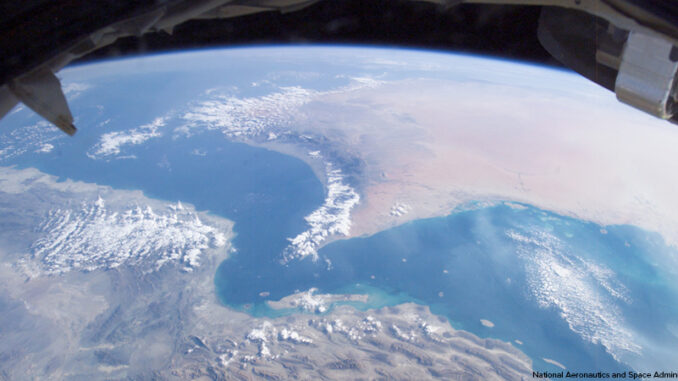
You may have heard a lot of talk lately about rising gas prices and political tensions with Iran. You may have even heard of a place called the Strait of Hormuz. But what is it, where is it, and why is it important? Also, how is it related to the amount of money we pay at the gas pump? Here, btw takes a closer look at the situation and why the strait is such an important geographic landmark.
What is the Strait of Hormuz?
The Strait of Hormuz is a narrow waterway, ranging from 35 to 60 miles wide. It connects the oil-rich Persian Gulf to the Gulf of Oman and, beyond that, the Arabian Sea. On the north side of the strait is Iran, and across it on the south side is Oman and the United Arab Emirates (UAE). In the center of the strait are international shipping channels two miles wide. These shipping channels are surrounded by a buffer zone of two miles on either side. The shipping channels themselves are mostly in Omani waters, but sometimes in Iranian. They are not controlled by any nation and are governed by international maritime law according to the United Nations Convention on the Law of the Sea.
Why is it Important?
The Persian Gulf is an important location to the whole world’s oil-based economy. The only way in or out of the Gulf is through the Strait of Hormuz. It is, therefore, the primary export route for petroleum and natural gas from Iran, Iraq, Kuwait, Qatar, Saudi Arabia, and the UAE. Every day, an average of 20.3 million barrels of petroleum and crude oil pass through the Strait of Hormuz and is exported to the rest of the world. That’s the equivalent of 25 percent of the world’s total maritime oil trade.
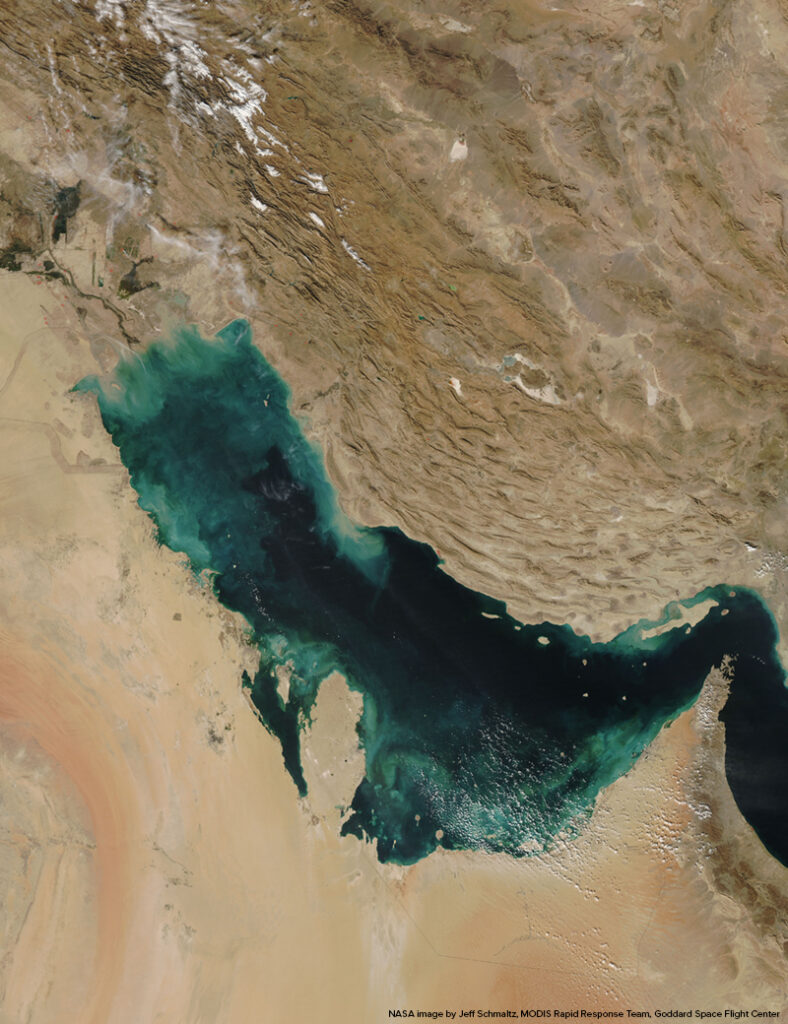
Recently, following the start of a military conflict between Iran, Israel, and the United States, Iran has cut off the flow of oil tankers through the strait. Iran doesn’t have the power to block the entire strait, because it doesn’t control the whole waterway. Plus, the strait is deep enough (over 650 feet in places) that even if Iran closes its portion, oil tankers can still pass through in Omani waters.
Instead, Iran is threatening and attacking ships in the strait. According to the U.S. officials, Iran has laid submarine mines in the strait. Just the threat of confrontation has caused a 97 percent drop in traffic through the Strait of Hormuz. This has led to a big disruption of the global oil supply. As a result, gas prices have surged worldwide.
Are There Alternative Routes?
Geographically, the Strait of Hormuz is the only waterway between the Persian Gulf and the Arabian Sea. But both Saudi Arabia and the UAE have built pipelines, which is an alternative way of moving oil out of the area. These pipelines don’t usually operate at full capacity. I they did, experts estimate that they could move about 2.5 million barrels of oil per day. The East-West crude oil pipeline runs from an oil processing center near the Persian Gulf to the Red Sea. It bypasses the strait entirely and moves up to 7 million barrels per day. The UAE also operates a 1.8 million barrel per day pipeline from onshore oil fields to the Gulf of Oman on the Arabian Sea.
In recent years, the United States has made efforts to be less dependent on oil from the Middle East. In 2024, the U.S. imported about 0.5 million barrels of crude oil per day from the Persian Gulf through the Strait of Hormuz. That’s only about 7 percent of total U.S. oil imports. Since then, our oil imports from Persian Gulf nations have dropped to their lowest level in nearly 40 years as the U.S. began to rely more heavily on oil imported from Canada instead.