
Have you ever celebrated a “milestone” birthday: a birthday that had special importance or significance? July 4, 2026, marks the United States’s semiquincentennial–the 250th anniversary of the adoption of the Declaration of Independence. This “milestone” birthday will be marked by special events and celebrations throughout the country. It’s also the fifth time in our nation’s history that a fifty-year “milestone” birthday has occurred. Here, btw takes a look back in time at the United States’ 50th, 100th, 150th, and 200th birthdays, and at how celebrating our nation has changed over time.
1826
The nation’s fiftieth birthday was an understated affair by modern standards. A commission was put together led by General Roger Chew Weightman, the mayor of the City of Washington (now Washington, D.C.). Weightman invited all living signers of the Declaration of Independence to attend the celebration. (John Adams and Thomas Jefferson both replied that they couldn’t attend due to poor health. Both men died on July 4.) Events included a dinner and party in Washington on July 4, followed by a memorial service for Adams and Jefferson four days later.
1876
As it happened, the United States’s one hundredth birthday overlapped with the first World’s Fair ever to be held in the United States. The combination of the two events brought more than ten million people from around the globe to the celebration in Philadelphia. The celebrations lasted for four months, from May 10 to November 10, 1876!
The overall purpose of the event was to celebrate the United States while also displaying its industrial and commercial power. There were exhibitions on site to showcase new inventions, including Alexander Graham Bell’s first telephone and Thomas Edison’s telegraph machine. The original Declaration of Independence was also put on display in Philadelphia for viewers to see firsthand. Another display housed the right arm and torch of the Statue of Liberty while it was being constructed. While not as well-attended as organizers had hoped, the exhibition did impress the rest of the world, which began to see the U.S. as a more important trading partner.
1926
To celebrate the nation’s 150th birthday, Philadelphia hosted a World’s Fair that was planned to last for six months. It included the building of Sesqui-Centennial Stadium, where many key events were held, such as sporting events, religious ceremonies, pageants, and displays. A five-acre amusement park was built, called “Treasure Island.” Part of the city was also recreated to look like Philadelphia’s High Street during the colonial period. High Street included twenty buildings and guides dressed in colonial clothing. Nevertheless, heavy rainfall and poor planning kept the crowds away, and overall, the event lost about $20 million.
There was also a strong military emphasis on this 150th anniversay. The Sesquicentennial International Exposition took place in Philadelphia, Pennsylvania, and lasted from June 1 to November 30, 1926. It included a 300-acre military encampment that visitors could tour, as well as the USS Constellation, which was the last sail-only warship. The Marine Band played music written for the occasion by John Philip Sousa, and the Navy’s opening of a new Philadelphia military airfield was attended by 1,500 people, including General Douglas MacArthur. Additionally, there were reunions held across the country for veterans of the Civil War, Spanish-American War, and World War I.
1976
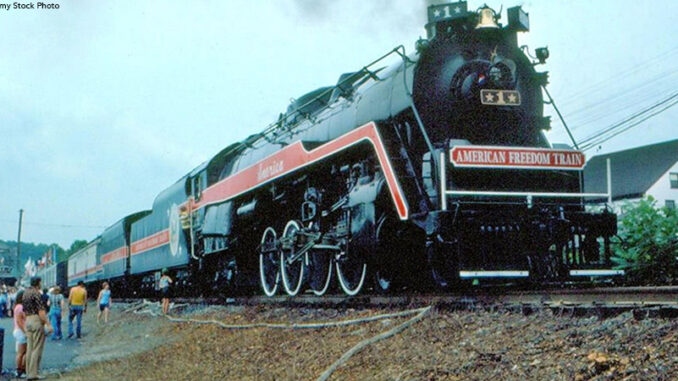
Planning for the bicentennial began ten years previously. In 1966, Congress passed a resolution to establish an official commission to spearhead the celebration, which went on for multiple years and spanned cities across the United States. One of the most significant events of the bicentennial was the American Freedom Train, a 26-car train that carried displays of important American artifacts and documents. One of the documents included the original Louisiana Purchase Treaty. The train travelled 25,000 miles, though all 48 contiguous states, and attracted millions of visitors. There was also the Bicentennial Wagon Train Pilgrimage, in which volunteers from every state traveled historical trails in covered wagons. In total, there were about 66,000 recognized bicentennial events, including a ball in honor of England’s Queen Elizabeth II, the ringing of the Bicentennial Bell, and numerous picnics, speeches, vigils, and festivals across the country.
Overall, the bicentennial celebration inspired strong feelings of patriotism across the U.S. After the controversial Vietnam War, the Watergate scandal, and the turmoil of the civil rights movement there was the sense that Americans were coming together to look toward a hopeful future.