
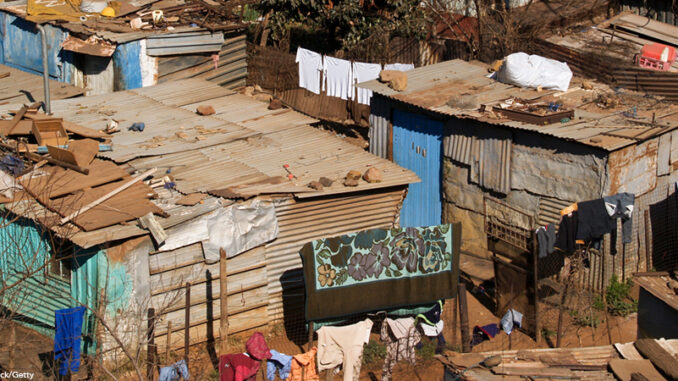
Does art have the power to change society? This year marks the fiftieth anniversary of The Market Theater in Johannesburg, South Africa. For the past half century, the Market Theater has been committed to telling authentic South African stories that were often challenging and sometimes even illegal. Let’s look at this unique theater, the impact it had during South Africa’s apartheid era, and the role it plays in the nation today.
Explaining Apartheid
In 1948, South Africa passed laws to keep the nation’s Black majority and white minority legally separated. These laws were called apartheid, an Afrikaans word meaning “separateness” or “being apart.” (Afrikaans is the language spoken by white South Africans.) Under the apartheid system, Black and white people could not marry or live together. Neighborhoods were designated as either Black or white areas. If a Black person went into a white area, they had to carry a passport, called a Dompas. Black people could not use buses, restrooms, or hotels that were designated for white people only.
In 1976, a group of Black South African students in the Soweto area of Johannesburg, South Africa protested apartheid education. The government opened fire on the protestors. This became known as the Soweto Uprising. Today, June 16 is a public holiday in South African honoring all young people who lost their lives in the fight against apartheid.
On March 17, 1992, after decades of protests and international pressure, white South Africans voted to end minority rule. In 1994, South African held its first free election and elected Nelson Mandela as the nation’s first Black president.
The “Theatre of the Struggle”
Just days after the Soweto Uprising, two South Africans named Barney Simon and Mannie Manim founded the Market Theater in an old Indian fruit and vegetable market in Johannesburg. The Market Theater broke all of the apartheid segregation rules. Audience members were both Black and white, sharing a space together. The plays told stories about South Africa and helped spread anti-apartheid messages. For this reason, it became known as the ‘Theatre of the Struggle’.
The owners looked for ways to circumvent apartheid laws. For example, at one point the theater was sold for the equivalent of fifty cents to a private entity, so that it could be privately-owned. Because apartheid laws only applied to public spaces, this made it legal for Black people to be in the theater audience. Even though the theater was often raided by apartheid government censors, they continued with its mission of producing authentic South African art, promoting artistic independence and free expression, operating with respect, honesty, and integrity.
A New Era
The Market Theater is still in operation, housing three stages and a bar/bistro. Over the past fifty years, the theater has won twenty-one international theater awards and more than three hundred South African theater awards. Many of today’s Market Theater audience members and actors may not have lived under apartheid. Nevertheless, the theater remains committed to telling South Africa’s stories. The focus of many of the plays today is on ongoing issues such as government corruption, equal access to education, and gender-based violence.