
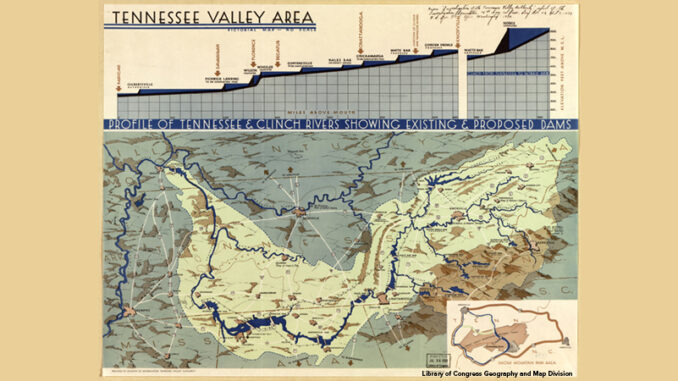
The TVA, or Tennessee Valley Authority was one of many government programs that began during the Great Depression. It was a part of President Franklin D. Roosevelt’s New Deal. Did you know that TVA still exists? Today it is the largest public power provider in the United States, serving about ten million people across seven southeastern states. Now, TVA is partnering with the state of Tennessee and the United Kingdom to work on a bold new development in nuclear energy.
What is TVA?
TVA was created by the U.S. government in 1933 to help improve living conditions and provide employment in the southeastern United States. Because of the Great Depression, people in the region were out of work, hungry, and struggling with the frequent flooding of the Tennessee River. These floods destroyed farmlands and businesses and increased the disease spread of malaria and typhoid fever. In 1933, President Roosevelt signed the TVA Act. The Tennessee Valley Authority provided jobs for workers to build dams, which reduced river flooding and harnessed the power of the river to bring electricity to the area. In the next ten years, TVA built and operated twelve dams across several states in the region. Over time, TVA began building coal plants and other energy sources, such as solar power and natural gas, to keep up with the growing demand for electricity in the region.
Today, TVA continues to provide power to the region, while also working to protect about 293,000 acres of public lands. More than 10,000 people work for TVA, from biologists to mechanics. In addition to providing electricity, TVA also operates campsites and other recreational areas along the river. TVA also works with state wildlife agencies to protect the plant and animal life in the area.
Project Infinity
As the need for electricity in the southeastern United States continues to grow, TVA is exploring new industries and technologies. Currently, it has paired up with the state of Tennessee and the United Kingdom to build the world’s first nuclear fusion plant. This initiative is called Project Infinity.
The use of nuclear power to provide energy isn’t new. But past nuclear power plants required the process of fission (dividing atoms) to generate power. Nuclear fusion is different. Fusion brings atoms together, while fission splits them apart. As the atoms combine, they release heat that can be used to produce massive amounts of power.
Pros and Cons
Advocates of the project say that fusion could provide a reliable, consistent energy supply at an affordable cost. Unlike gas and coal, the price of fusion energy doesn’t fluctuate; it remains the same. This is significant now, when many people are concerned that computer data centers are increasing electric energy demand and causing electricity prices to rise. The project will likely also create high-tech job opportunities. According to TVA, fusion emits only low levels of radiation and produces no carbon emissions or long-term radioactive waste. Fusion plants also have a lower risk of meltdown than fission plants.
However, some Republican and Democratic lawmakers have expressed concern about the project. They are worried about the dangers of nuclear reactors, how much fuel will be spent, how much radioactive waste will be produced, and where the waste will go.
Looking Ahead
The United States and the United Kingdom have already invested billions of dollars exploring the fusion nuclear reactors. The next steps include hiring and training enough workers, securing supply chains, and setting up legal regulations. The federal government is not responsible for setting laws to regulate nuclear fusion; that falls to the individual states. This means that Tennessee may be the first state to set up rules and regulations for it.
Groundbreaking on the new fusion plant is scheduled for later in 2026. If all goes as planned, the plant is scheduled to be fully operational by 2034.