
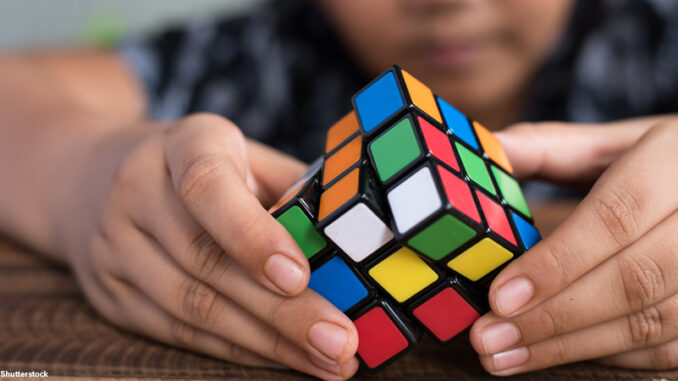
Have you played with a Rubik’s Cube? It’s the colorful cube that can be turned this way and that. The goal of the original puzzle was to unscramble the sides and make each of the six colors land on separate cube faces.
But do you know where the toy’s name comes from? The classic puzzle is named for its inventor, Erno Rubik. Though originally produced in Rubik’s native country of Hungary, a series of events brought the creation of the toy to the United States. Now, the Rubik’s Cube is going “home,” to be manufactured in Hungary once again. Here, btw takes a look at the story of the Rubik’s Cube.
A Classic is Born
Erno Rubrik is a Hungarian architect, sculptor, and professor. He invented his cube toy in 1974, when he was teaching design at the Academy of Applied Arts and Design in Budapest. He wanted to teach his students about spatial relationships and three-dimensional movements. The first cube was made of wood. It was three inches by three inches and contained 27 blocks rotating on multiple axes. The first production run of the cube was 5,000 units. It wa originally called the “Magic Cube.” Each Magic Cube was made by hand and sold in specialty shops in Budapest. They quickly became popular, and demand grew.
However, at that time, Hungary was heavily influenced by the Soviet Union and was a member of the Warsaw Pact. These communist connections made it difficult for Rubik to get the materials he needed to produce the cube on a worldwide scale. So, he licensed the design to a British toy company, and then to an American one.
In 1980, it was renamed “Rubik’s Cube” and won the designation of “Game of the Year.” From 1980 to 1983, two hundred million units were sold. It continues to sell millions of units per year worldwide. More than half a billion units have been sold since its creation more than half a century ago!
The Cube Moves Home
Today, the Rubik’s Cube trademark is owned by a Canadian toy company called Spin Master, which has moved its production back to Hungary. There, a series of robots will assemble and test the cubes, with plans to produce one million annually. This production line will also create 27 new jobs for humans. The decision to relocate production of the cube was made by Spin Master to help bring production closer to key European markets. It is also a symbolic “homecoming” to the place where the toy first originated.
The start button on the new assembly line was pressed by Erno Rubik himself, who is now 82 years old. The first cube produced by the new line will not be sold. Instead, it will be auctioned, with the proceeds benefitting the local St. Elizabeth Hospital.
From Toy to Icon
Part of the reason for the continuing popularity of Rubik’s Cube is that it has always been seen as more than just a toy. Rubik himself views it as a combination of art and engineering. Solving the cube is considered an intellectual challenge and a sign of intelligence. In 1982, the first Rubik’s Cube World Championship took place. Since then, contestants across the globe continue competing to see who can unscramble the six cube faces the fastest. The current world record, set in 2026, is held by Xuanyi Geng. This nine-year-old from China, solved a scrambled cube in just 2.51 seconds!