
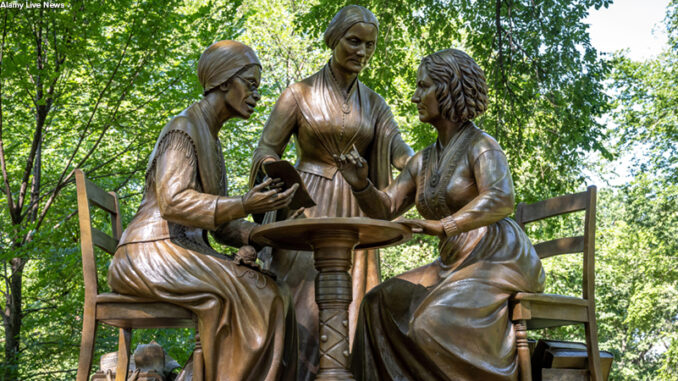
March is Women’s History Month: a time to recognize and celebrate the history, achievements, and stories of women and girls around the world. This week btw looks back at how Women’s History Month began. And let’s look at a few of the ways that some museums and other institutions are honoring it today.
Women’s History Week
Women’s History Month actually began as a week. It started as a local celebration in Santa Rosa, California, on the week of March 8, or International Women’s Day. From there, the celebration spread to other communities across the country. In 1980, President Jimmy Carter issued a Presidential Proclamation officially declaring the week of March 8, 1980, as National Women’s History Week. In 1987, this was expanded to designate the month of March as Women’s History Month nationwide.
The Nation’s Museums Celebrate
In honor of Women’s History Month, many of the nation’s museums are featuring special events and exhibits focusing on women. The Smithsonian Museum of African American History and Culture is hosting an exhibit called “Forces for Change: Mary McLeod Bethune and Black Women’s Activism” about African American women, past and present, who have fought for social justice.
The exhibit features 75 images, a film, and 35 artifacts, including an eight-foot-tall sculpture of Mary McLeod Bethune, a famous educator and reformer. Meanwhile, the National Gallery of Art is hosting an exhibit on Mary Cassatt, the iconic impressionist American painter. The exhibit, which marks the hundredth anniversary of Cassatt’s death, includes forty pieces of her work.
Celebrating Outside
But you don’t have to visit a museum to celebrate women, and you don’t have to do it in March. The National Park Service invites everyone to visit one of more than four hundred national parks across the country to learn more about the role that women have played in the story of the parks.
One special park of note is the Women’s Rights National Historical Park in Seneca Falls, New York. This park commemorates the first Women’s Rights Convention, held in 1848. Also in New York is the Eleanor Roosevelt National Historic Site, where the influential First Lady once lived.
There is plenty to explore outside of New York as well. The Harriet Tubman Underground Railroad National Historical Park, located in Maryland, honors Harriet Tubman, the Underground Railroad’s most famous conductor, who guided 70 enslaved people north to safety.
And in California, at the Rosie the Riveter WWII Home Front, you can learn all about the contributions of women on the home front during World War II, as well as visit the Rosie the Riveter Memorial. The Memorial celebrates the contributions of women during the war years, but also recognizes the challenges they faced, such as hazardous working conditions, childcare shortages, and food rationing.
Is There a Women’s History Museum?
While there is a Smithsonian American Women’s History Museum, it doesn’t exist in physical form – yet. Currently, the Women’s History Museum is a decentralized, digital-first organization, meaning that anyone can go online to explore the Museum’s resources and learn more about the contributions of American women throughout history.
To honor Women’s History Month this year, the Museum is offering several exciting events at different locations and online. “We Do Declare” is a collection of oral histories from different generations of women across the country talking about the fight for financial independence over the past fifty years.
The Museum is also hosting an event called “Hidden Figures, Visible Future: Women in Space” in Houston, Texas, to explore women’s hidden contributions to space exploration. Panelists will include Kathryn Sullivan, former NASA astronaut; Ellen Ochoa, the first Latina to travel to space; and Margot Shetterly, author of the book Hidden Figures.
The mission of the Women’s History Museum, which eventually hopes to have a physical home on the National Mall in Washington, D.C., is to share the untold stories of women throughout American history who have shaped our past, to inspire the women and girls of the future.