
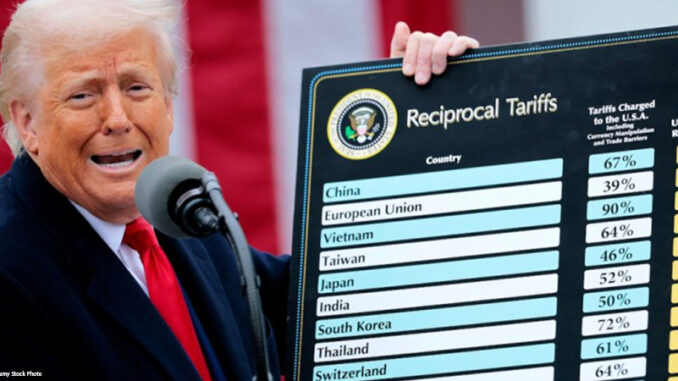
One of President Trump’s signature actions in his second term was to pass the International Emergency Economic Powers Act (IEEPA), which placed an extra fee, or tariff, on goods imported to the United States. In February 2026, the U.S. Supreme Court declared these initial tariffs unconstitutional. The Court ordered the Trump administration to pay back about $166 billion to the more than 330,000 businesses that were impacted by the tariffs. Last week, these businesses began applying to get their money back.
What Exactly Are Tariffs?
Tariffs are extra fees placed on goods coming into the United States from other places. If you ordered a shirt online from a company based in a different country, you would have to pay the original cost of the shirt to the company, plus the extra tariff to the U.S. government.
The Trump administration’s goal was to encourage people to buy American products, because (thanks to the additional fees, or tariffs) goods made in America would now be cheaper than goods made in other countries. The result, however, was that the price of many items (such as medicine and technology) increased for the American public. Eventually, the Supreme Court declared the tariffs unconstitutional, saying that the president does not have the right to levy taxes, including tariffs, on the American people. (The U.S. Constitution gives this right to Congress.) And now, the Trump administration must pay that money back.
How Does the Refund Process Work?
U.S. Customs and Border Protection (CBP) has developed a program called CAPE (Consolidated Administration and Processing of Entries) to accept, handle, and process requests for refunds of tariffs paid. The process is being carried out in phases, with the first phase launched successfully on April 20, 2026.
In order to receive a refund, eligible businesses must log on to the U.S. tariff refund portal, where they can upload receipts and provide their bank account information. After that, they should receive a refund within sixty to ninety days.
Can Customers Get a Refund Too?
You and your family have probably been paying more than you used to for everyday items. That’s because sellers have included the price of the tariff in what you pay for the product – in other words, some businesses may have passed the cost of the tariffs on to you in the form of higher prices. Are consumers allowed to get their money back?
Probably not. Experts say it’s too difficult to figure out exactly what portion of those higher prices was due to tariffs and what portion was due to other factors, such as inflation. Plus, some items (such as televisions) are made from parts that came from several different countries, often with different tariff rates, making it impossible to calculate how much extra the customer wound up paying because of tariffs. Some consumers have filed lawsuits against major companies to try to get some of that money back anyway. Most companies, such as Costco, have indicated that they will try to make things right with customers by lowering prices going forward to provide better value. Some shipping companies–such as Fed, DHL, and UPS–have stated that they will issue direct refunds to consumers who had to pay tariff fees directly.