
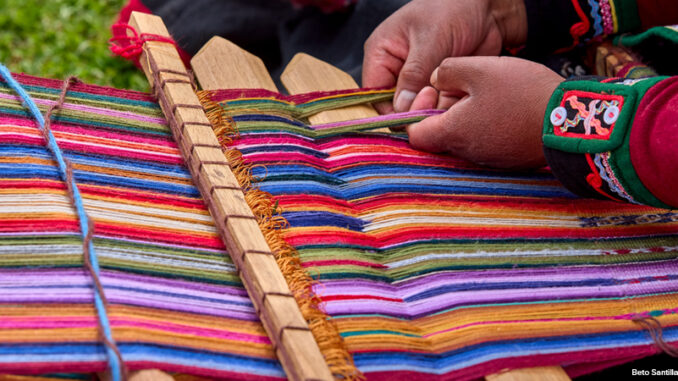
Imagine that you are told that you can’t participate in your favorite activity because of your gender. Imagine that if you wanted to keep doing that activity anyway, you would have to do it in secret, or face scorn and punishment. Mexican artist Xaneri Merino has experienced this. She was punished for weaving when she was young because she was born a boy. Here, btw takes a closer look at Merino’s story.
Secret Weaver
Xaneri Merino was born in San Pedro Jicayan, an Indigenous community in Mexico. In this community, men were expected to work in the fields and take care of livestock. They were not permitted to engage in artistic activities such as weaving. Merino, who was identified as a boy at birth, learned how to weave from her grandmother in secret when she was about 13 years old. Merino’s grandmother taught her the ancient ancestral practice of backstrap weaving, and how to use natural materials to make threads from scratch.
When she was fifteen, Merino’s neighbors spotted her weaving. The next morning, loudspeakers across the community announced that all the men needed to come together to discuss the fact that a boy in their community liked to weave. At this meeting, Merino and her mother and grandmother stood while the men sat in a circle around them. The men interrogated them and decided that Merino’s punishment would be to sweep the local church.
Merino kept weaving in secret occasionally after that, but she found that she didn’t enjoy weaving nearly as much as she had before.
A New Life
A few years later, Merino went away to college in Mexico City, where she majored in communications and took classes in textile studies and Indigenous resistance movements. She began to see how weaving might be a way for her to celebrate her Indigenous roots and resist the oppression of harmful gender norms and expectations.
Today, Merino identifies as a trans woman. She also uses the term “muxe,” which is a Zapotec word for Indigenous people who are identified as male at birth but take on women’s roles. Merino makes her living as a weaver and a weaving teacher in Mexico City. She holds workshops for LGBTQ+ people and other groups. She teaches them how to weave as an act of beauty and resistance. Merino shows them how to weave in the traditional method taught to her by her grandmother, by using a “backstrap loom:” a simple, portable loom made up of cords, threads, and wooden rods. To weave on the looms, weavers will sit on the ground and tie one end of the loom to a tree and fasten the other end around their waists. By moving back and forward, they are able to adjust the tension of the loom.
Merino herself weaves for about eight hours every day. It takes her about a month to finish a short “huipil,” which is a tunic worn by Indigenous women in Mexico. She has also authored a picture book for children called “Xaneri: A Muxe Childhood.”