
Are you familiar with the excitement surrounding major sporting events such as the World Cup, March Madness, and the Super Bowl? There is also a Cricket World Cup. The sport of cricket isn’t as well known in the United States. But boasts about 2.5 billion fans across Asia, Australia, and the United Kingdom. It is second only to soccer in global popularity. But the game also has a troubling history rooted in British colonialism. Here, btw takes a closer look.
What is Cricket?
In cricket, there are two teams, each made up of eleven players. A match is played at a cricket ground, which is a large flat grassy area, usually in the shape of a circle or oval. Teams take turns batting and fielding, just like in American baseball. However, when players bat, they do it in pairs. And also, like baseball, the goal is to score more runs than the other team.
But that is where the similarities between the two sports end. In the middle of the cricket field is a long, narrow area called the pitch. At each end of the pitch is a set of three sticks called the wickets.
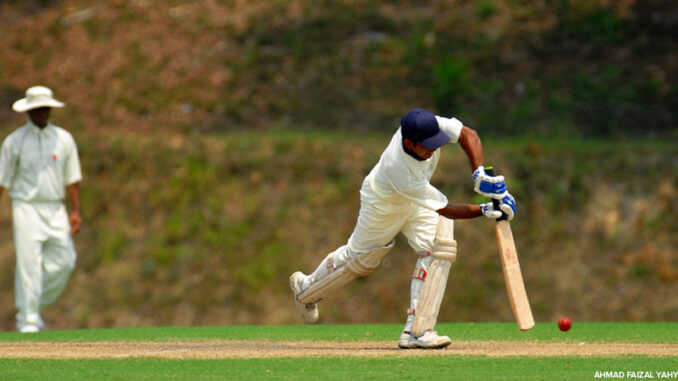
When it is time to bat, one player (the batsman) stands at each wicket, and the bowler (like the pitcher in baseball) throws the ball toward the batsman’s wicket. The batsman tries to hit the ball with a flat bat.
When the ball is hit, the two batsmen run to the opposite ends of the pitch. If they can switch places once, one run is scored. If they can switch twice, that’s two runs, and so on. (Think of running the bases in baseball, except in cricket, the players run back and forth between the wickets.) If the ball reaches the boundary of the cricket ground, it counts as four runs.
History of the Game
But cricket isn’t just a sport; its history was influenced colonialism and politics. While the exact origin of cricket isn’t known, there are records of matches played in England as far back as 1300. By the seventeenth century, it was popular in rural communities, and by the eighteenth century cricket was widely played by the poor and wealthy alike. In 1909, the Imperial Cricket Conference was created to oversee cricket worldwide, and included representatives from the United Kingdom, Australia, and South Africa. (It was later renamed the International Cricket Council.)
In the mid-1700s, when the land that would become modern India was a British colony, cricket was introduced by British East India Company sailors. At that time, it was an elite sport reserved for the wealthy upper classes. But over the next century, the game’s popularity spread throughout all of India. In 1932, India began participating in international test matches.
Cricket and Women
While cricket came to India via colonialism, today it can also be seen a source of empowerment, especially for young women in India. Before 1913, the sport was relegated to male players only. That year, for the first time, an Australian schoolteacher in India named Anne Kelleve made it mandatory for girl at her school to learn cricket.
Fast forward to November 2025, at last year’s women’s Cricket World Cup. This contest was remarkable for several reasons. All of the match officials were female. Second, the prize pool came in at around $13.88 million (in U.S. dollars), showing the sport’s remarkable popularity. It included eight teams from around the globe, with Australia as the favorite. (The Australian women’s team had won the women’s World Cup seven times before.) India, on the other hand, had never won the title before. But for the first time ever, the India women’s cricket team won the Cricket World Cup, after defeating South Africa–the defending champions–in the final.